
Have you ever wondered why there are so few true experts? Most of us have probably experienced a situation where we didn’t receive proper help from a specialist. What is more sometimes their actions turned out to be incorrect or even harmful. This applies to every profession, from plumbers to doctors. So why is it so difficult to become an expert?

This article is divided into two section. First one presents the reasons why there is so few true expert. In the second, you will find what I consider the most important solutions. Let’s begin.
Tabel of content
1. Experts need knowledge
Every field of knowledge contains enormous amount of information to learn. To make matters worse, all areas of knowledge are interconnected. They form a complex web of links and dependencies. To become an expert in one domain you need at least a basic understanding of several related fields.
And in the middle of this are we — humans whose brains evolved primarily for survival on the savannah. Clearly, that has little to do with calculus or atoms.
Everything our ancestors needed to remember had to matter for survival. While this was essential for survival, it offers little advantage in information-dense world.
Limitations of short-term memory
On top of that, our memory can only handle a limited amount of information at once. Most of us can store just 3-5 information in short term memory at a time. It makes learning new, complex ideas much harder.
All of this means we end up remembering very little. It creates a hidden problem in skill development that isn’t obvious at first glance.
Experts need knowledge - Summary
Every field of knowledge contains a vast amount of information.
Human brain didn’t evolve to handle abstract information.
Short-term memory can store only a few pieces of information at once, making learning difficult.
2. The Pareto Principle in Building Expertise
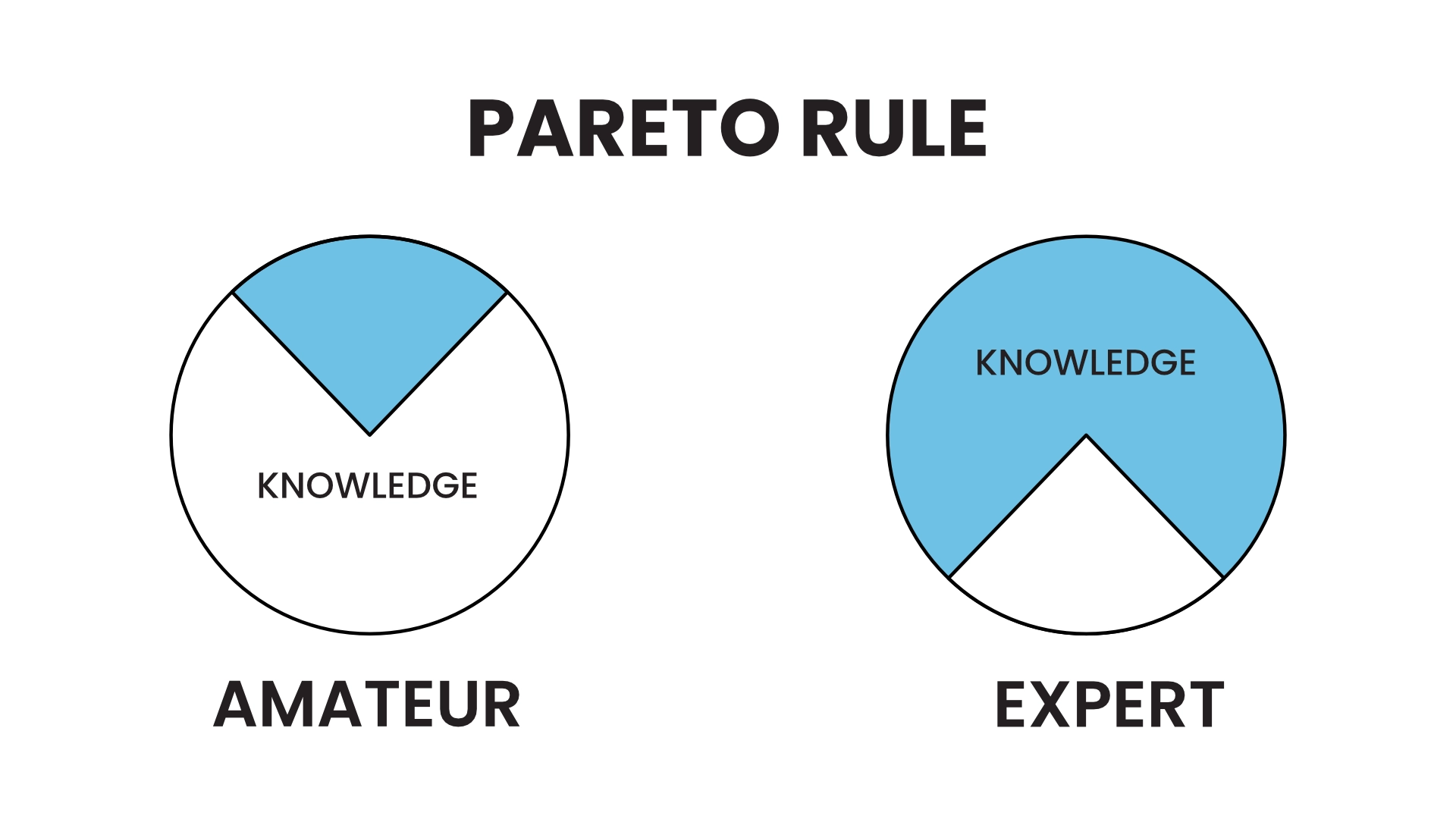
The well-known principle formulated by Vilfredo Pareto states that 20% of variables account for 80% of results. These numbers aren’t exact—they represent a general idea. For example, in the book industry, a small percentage of titles accounts for the vast majority of sales.
why people fail to become an experts?
In the same way, 20% of knowledge will solve 80% of problems. Add how poorly we remember information to see why there are so few true experts. Only few people take enough time to acquire the remaining 80% of knowledge.
That’s why, if you face an unusual issue, there’s a good chance you’ll need to consult more than just a few specialists.
The Pareto Principle - Summary
The Pareto principle – small portion of inputs produces the majority of results
Roughly 20% of knowledge solves most common problems.
Expertise requires the remaining 80% of knowledge
3. No expertise without current knowledge
It’s not enough to have a lot of knowledge. To become an expert you need to stay up-to date.
Nowadays, every field is evolving faster than ever before. The number of scientific papers published each year far exceeds the time we have to read them. Considering daily responsibilities, the time available to learn new information is limited.
People don't like changes
We can’t ignore human nature. People aren’t naturally inclined to change. Keeping your knowledge up to date requires changes. It means you need to constantly update your opinions and information you have. As a humans, we don’t like spending mental energy on things we’ve already figured out.
Current knowledge - Summary
- Expertise requires staying up to date
- The pace of new research and information exceeds the time most people have to consume it
- Changes in beliefs and knowledge are mentally demanding
4. What you need to become an expert?
After everything we’ve discussed so far, you may think that becoming an expert is almost impossible. And, of course, it is challenging. However, I didn’t write this article to complain about it. With the right tools and mindset journey to expertise can be a lot easier.
When we look at the challenges we’ve outlined, they revolve around key areas like:
- learning
- productivity
- time management
- mental preparation
The goal is to find universal solutions that help more people to become an true expert. Journey will not be short and easy but challenging and satisfying.
5. Remember more information
Learning is essential in skill development
As I hope I’ve already convinced you, solving any problem requires information. The more complex and unique the problem is, the more information we need.
To acquire knowledge effectively we need learning system. Without an effective system progress becomes slow and frustrating. One of the foundations of effective learning is the use of programs based on spaced repetition.
Forgetting curve
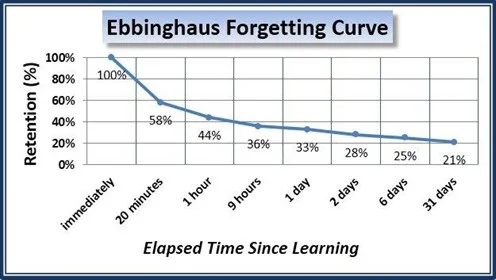
These apps base their algorithms on the Ebbinghaus forgetting curve. German psychologist Hermann Ebbinghaus introduced it nearly 150 years ago.
The curve describes how quickly we forget information over time. Based on this principle, such apps present knowledge at carefully chosen moments to improve long-term retention.
Don't limit yourself to one method
Proper use of spaced repetition apps allows us to absorb and retain information for longer than with methods used by most people. The more you remember, the faster you acquire new knowledge and solve problems.
True expert should not limit to one learning method. Apply other methods like Feynman technique to your skill set.
Works for me
Personally, I use Anki as my spaced repetition app. It is an open-source application that allows users to customize it for their specific goals. It is free on most devices except iPhones. You can find more information on their website.
Remember more information - Summary
- Solving problems requires information and an effective learning system.
- Spaced repetition is foundation of effective learning system
- Spaced repetition significantly improve long-term retention compared to common methods
6. Solve more problems to become an expert
Regardless of your current level, information that is not used to solve problems is forgotten quickly. Moreover, memorizing information without a purpose is not only ineffective, but also impractical. Who needs an expert who remembers a lot but cannot fix anything?
Why solving problems is necessary to become an expert?
Whether you are a beginner or an advanced, you should always look for more problems to solve. They are important for 2 reasons:
- Problems test what you already know
- Problems push you to learn new information necessary to solve them.
What’s interesting you don’t need to solve real-world problems to gain benefits. Our brains treat both real and imaginary problems in similar way.
Every time you don’t have real problem to solve, you can create your own. Creating or solving new problem follow one rule:
The challenge must slightly exceed your current skill level.
In addition, every solved problem makes the next one easier. Over time, you start to notice clues and similarities to problems you have faced before. These, in turn, act as triggers that bring information back to mind. Some of them may be useful in solving current problems.
Solve more problems - Summary
- Information that isn’t used to solve problems is quickly forgotten
- Solving problems test knowledge and reveals gaps
- You should always look for both real and self-created problems
- Solved problems attract information like magnet
7. Set priorities to avoid disappointment
Every choice we make comes with potential gains and losses. Suppose you spend time watching a TV series instead of cleaning your house. You gain enjoyment, but your house remains messy. Similar examples are everywhere.
How to mentally prepare to become an expert?
Some choices are obvious and require no hesitate. However, becoming a top tier specialist often involves sacrifices that are less obvious like family, health or money. That is why it is worth setting priorities and boundaries early on.
Setting clear priorities helps you avoid frustration and maintain life-work balance. The mental aspect is just as important as the technical side of developing expertise. I recommend asking yourself a question: How much are you truly willing to sacrifice to become an expert?
8. Develop expert mindset
It might seem that becoming an expert is a final, fixed goal. Unfortunately, nothing could be further from the truth. Achieving expertise is a continuous process that never end, so we should prepare for it mentally.
To achieve mastery will be helpful to adopt mental model from life-long learners. For life long learners, no amount of information to learn is ever truly enough. We can implement continuous learning in our life by developing curiosity and consistency.
9. The world won't wait
The journey to expertise doesn’t stop here. It’s a multi-stage process that can always be expanded further. If you found this article interesting, check out more articles about building expertise and effective learning. Feel free to share your thoughts with us.
10. Sources
The Black Swan by Nassim Nicholas Taleb
Limitations of short-term memory