
Lifelong learning accompanies most of us whenever we like it or not. The way we approach it shapes our future decisions, the pace of knowledge acquisition and the consequences that follow.
Before we explain what intellectual arrogance is, let’s see what the U.S. Secretary of Defense has to offer on this topic.
Tabel of content
1. Unknown Unknowns
Simple way to Categorize Knowledge
In 2002, during a press conference, the then U.S. Secretary of Defense, Donald Rumsfeld, introduced a simple yet powerful way of categorizing knowledge. According to this idea, we can divide what we know into:
- known knowns
- known unknowns
- unknown unknowns
There are known knowns. These are things we know that we know. There are known unknowns. That is to say, there are things that we know we don’t know. But there are also unknown unknowns. There are things we don’t know we don’t know.
The statement touches on the idea of self-awareness of knowledge limitation. Before we dive deeper into intellectual arrogance, let;s clarify the few concepts:
- known knowns – all the information we are familiar with to some extent. It can be anything from the quantum mechanic to chemical formula of water.
- known unknowns – all the information we are aware of, but know little or nothing about
- unknown unknowns – all the information we are completely unaware of.
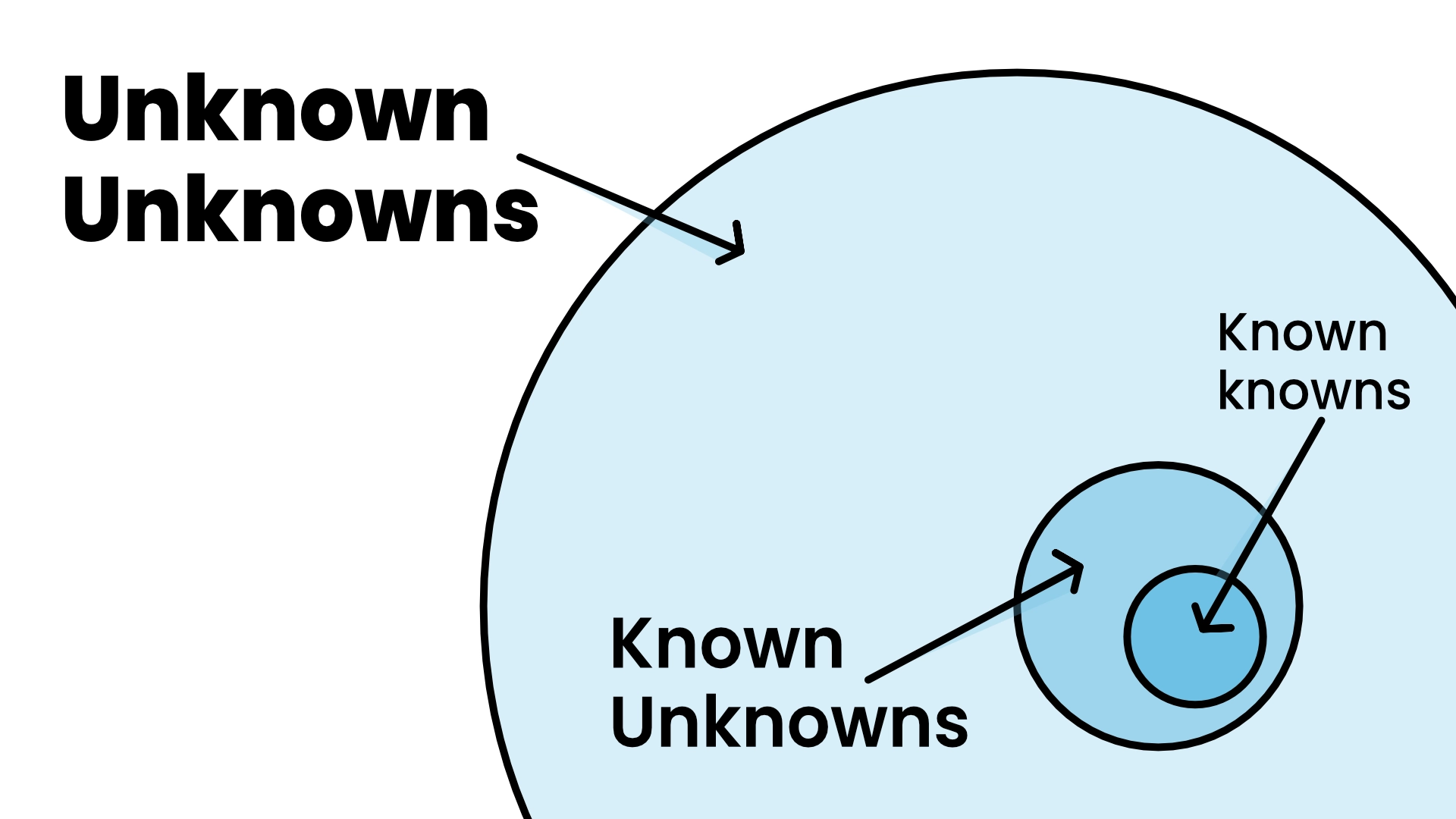
For each of us, the distribution of information across these three categories looks different. It depends of our hobbies, environment we live in, career path and many other factors. However, there is one thing that should unite us together. We all need to discover our unknown unknowns.
Unknown Unknowns - Summary
Every knowledge domain comprises of huge amount of information that we are unaware of
Your goal should always be to discover unknown unknowns
2. Certainty - source of intellectual arrogance
Dangers of certainty
Everyone makes mistakes – it is an inevitable part of life. However, what truly matters is the weight of those mistakes. You’ll probably agree that doctor choosing wrong therapy that kills a patient made a far worst mistake than doctor who misspell patient name.
Mistakes that lead to catastrophic consequences often stem from:
- arrogance
- complacency
- lack of awareness of own knowledge limitations.
One wrong decision rarely lead to critical mistake, it is more often result of series of small mistakes. The snowball effect illustrates this perfectly. Most of us associate it with positive outcomes, such as in investing, but it can also work the other way around.
Most failures don’t happen suddenly — they accumulate quietly.
Catastrophe is often the final chapter of a long story of small ignored lessons.
Consider someone who doesn’t take care of own health. Every day, small decisions move them closer to serious health problems like cancer or heart attack. We underestimate how much these seemingly minor choices accumulate over time
Complexity of knowledge
On the other hand, we are underestimate how much we don’t know. People tend to overly simplify complicated matters. In any field, amount of information necessary to become an expert is gargantuan. In every domain you need to absorb thousands or hundred of thousands concepts.
What makes it even more challenging is that most disciplines are intertwined with others. We first time experience it in primary school, learning chemistry required understanding elements from math, physics and biology.
These problems affect all of us, making effective decision-making more difficult. Fortunately, we can learn to minimize theirs negative impact.
Certainty - Summary
- Critical errors stem from intellectual arrogance, complacency and lack of awareness of own knowledge limits.
- Most critical errors are result of series of small wrong decisions.
- Complexity and connection between domains make it difficult to estimate our knowledge limits.
3. Overconfidence and intellectual arrogance
It is astonishing how confidently we approach our own knowledge. Many of us after reading few articles and books start to see ourselves as experts in a given field. We feel confident enough to say we have mastered this domain.
This cognitive bias was first described in the early 2000’s. It is known after Dunning-Kruger effect after researchers names.
2 sides of Dunning-Kruger effect
The researchers observed that beginners tend to overestimate their knowledge and abilities. In other words they believe they know more than they actually do. Professionals, on the other hand, underestimate their own competence.
As lifelong learners professionals repeatedly encounter new concepts that they never seen before. Such moments shatter the illusion of complete understanding. It is one of the many reason why lifelong learning is so valuable.
Challenge your assumptions
Whenever you feel too confident about what you know, ask yourself whether that confidence is built on solid ground or just a fragile illusion?
It’s far better to confront this question privately than to face a real-world situation that exposes your weaknesses. Don’t forget that real practice remains essential part of learning process and cannot be skipped.
Overconfidence and Intellectual Arrogance - Summary
- Dunning-Kruger effect affects all of us
- Beginners tend to overestimate their knowledge and abilities
- Professionals often underestimate their own competence
- Lifelong learning helps prevent overconfidence
- Always challenge your assumptions – they might be wrong
4. What is intellectual arrogance?
Up to this point, the article has focused on cognitive biases, the human ego, and our lack of awareness about how little we actually know. But what exactly is the so-called intellectual arrogance?
It’s difficult to find a precise, encyclopedic definition of this concept. However, we can describe it as a collection of cognitive biases and human behaviors that lead to more or less serious consequences, depending on the situation.
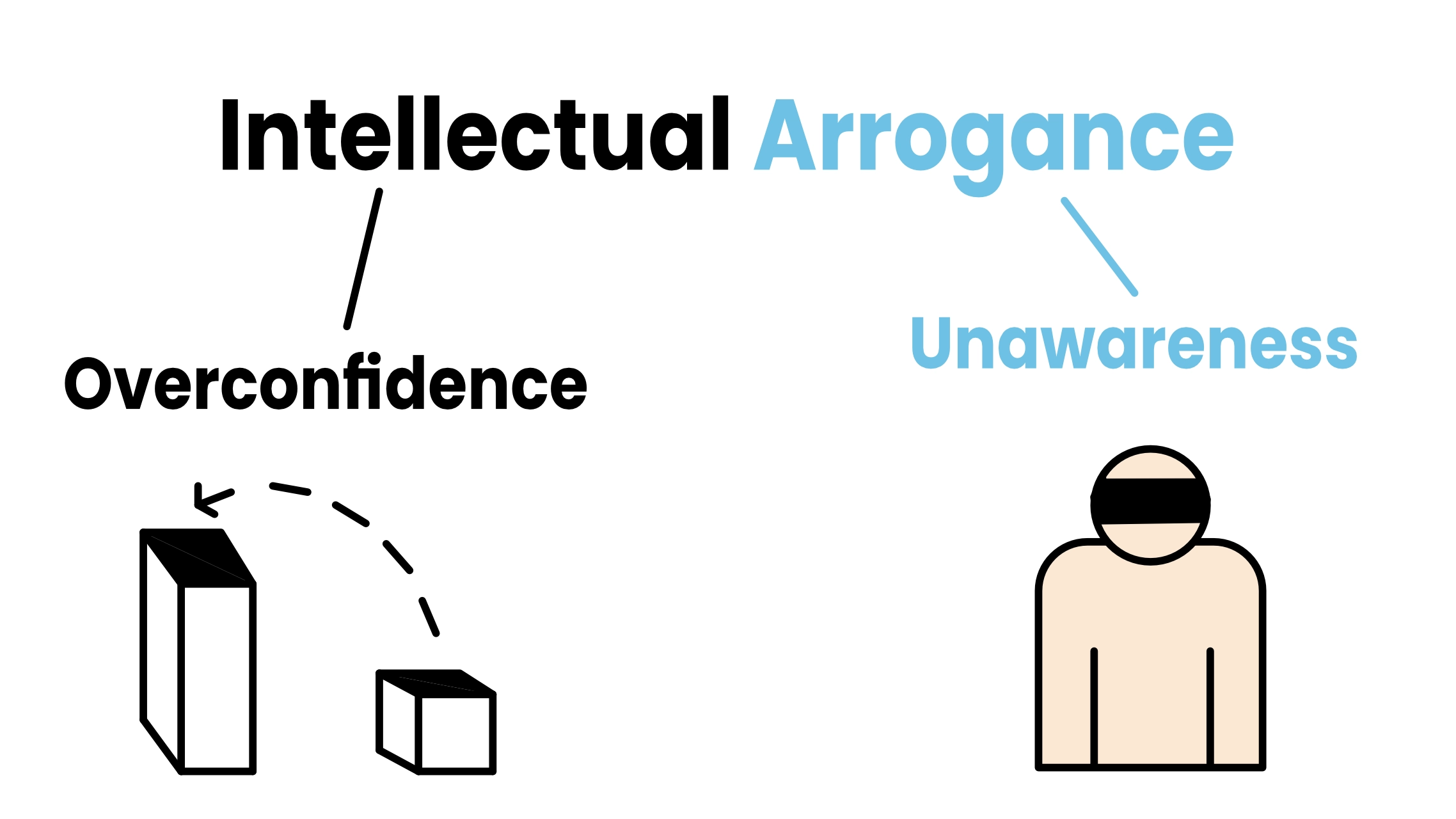
In my view, the most significant aspects of intellectual arrogance are excessive self-confidence and the lack of awareness of one’s own knowledge.
5. How awareness mitigate intellectual arrogance?
Simply being aware that certain information exists is already better than complete ignorance. That’s why we should turn as many unknown unknowns into known unknowns.
It enables us to include them into decision-making process. The more information we consider, the less probable we make critical error.
Knowledge Mapping
One of the simplest method to achieve this is knowledge mapping. Everything you need to do is finding as much new information as you can. For example:
- When learning about the nervous system, find a list of its components — tissues, hormones, and mechanisms.
- When learning a new programming language, explore its list of commands, syntax rules, and libraries.
- When studying car design, look for a complete list of parts that make up a vehicle.
How can AI faster knowledge mapping?
Artificial intelligence is a powerful tool for knowledge mapping. It helps you identify new concepts in few seconds. It significantly reduces time we spend on searching.
Some websites like Wikipedia provide comprehensive lists of key topics in various fields. Beside of previous methods, it is also helpful to browse the table of contents from books and online courses related to your area of interest.
Awareness - Summary
- Being aware is better than complete ignorance
- Try knowledge mapping in every subject you learn
- AI and Wikipedia significantly reduce time required for knowledge mapping
- Add knowledge mapping to your learning process
6. Something for books lovers
If you love learning from books, you might enjoy the concept similar to knowledge mapping. It is Umberto Eco’s antilibrary. Nassim Taleb introduced this concept in his bestseller ,, the Black Swan”.
Umberto Eco, an Italian writer and philosopher, during his lifetime collected over 30 000 books. If your first thought is ,, does he read them all”, the answer is no.
As he said, the unread books are far more important that the ones that we’ve already read. They remind us how much knowledge awaits us. Unread books are tangible symbol of unknown unknowns.
Why you should buy more books?
If you enjoy reading, buy more books than you can finish. First of all, you’ll always have something new to read. However, what is more important you can switch between books when one starts to boring you. This helps to maintain reading habit without forcing yourself.
Naval Ravikant take advantage of similar reading technique. He is an angel-investor and multi-millionaire who invests in start-ups on early stage. His library enables him to read several books at once. This simple method helps to keep curiosity and enjoy of reading on high level.
Antilibrary - Summary
- Buy more books than you can read
- Unread books are a physical symbol of the complexity and vastness of knowledge
7. Conclusion
Access to the Internet has given everyone the opportunity to become an expert in any field. Moreover, you don’t need to spend millions to achieve it. Yet, only a small percentage of people truly succeed. Most people fail because of our ego and unawareness of own’s knowledge limitations. To truly master the field, you need to map your knowledge and keep your ego under control. It isn’t simple but helps to make better decisions.
Expand your horizons
Anti-aging – Look what modern science say about longevity
Sugar – Discover methods to reduce sugar in diet
8. Sources
Intellectual arrogance and humility
Dunning-Kruger effect – basic information
Dunning-Kruger effect – first occurance in scientific paper
Unknown unknowns – first time Donald Rumsfeld presented concept
Umberto Eco’s antilibrary – The Black Swan by Nassim Taleb
Naval’s reading techniques – The Almanack of Naval Ravikant: A Guide to Wealth and Happiness by Eric Jorgenson